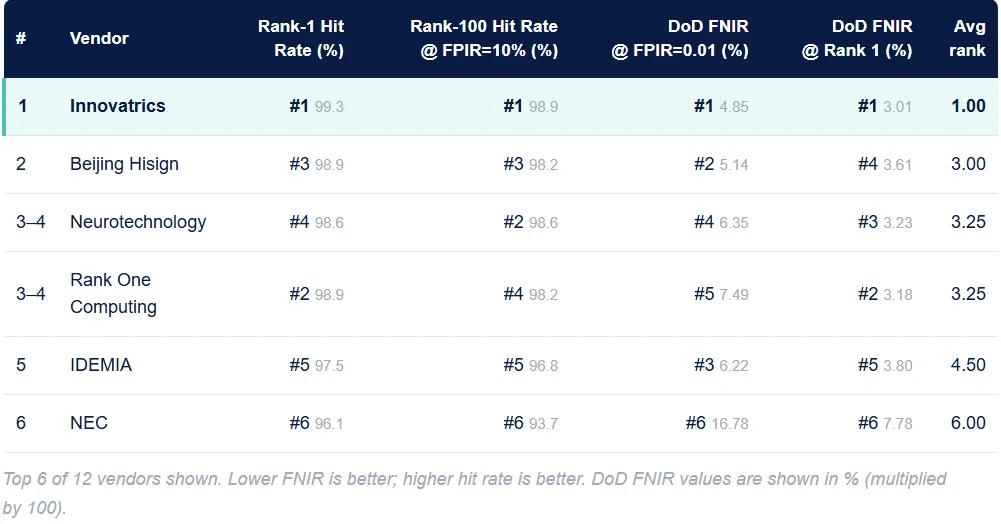
The latest NIST Evaluation of Latent Friction Ridge Technology (ELFT) results place Innovatrics first across four selected measures of latent fingerprint identification accuracy in a comparison of 12 vendors. This comprehensive evaluation covers both rank-based and threshold-based latent fingerprint searches.
NIST’s ELFT benchmark measures how accurately algorithms can search for latent fingerprints against large reference databases. These prints are often partial, unclear, or recovered from surfaces at crime scenes. NIST rigorously evaluates these searches using raw fingerprint images alone, as well as searches supported by features manually marked by experienced forensic examiners.
The comparison highlights Innovatrics’ top-tier performance across four specific metrics reported by NIST:

Rank-1 accuracy indicates how often the correct subject appears at the very top of the candidate list presented to a human examiner. By achieving a 99.3% Rank-1 Hit Rate, Innovatrics secured the highest result in the selected vendor comparison.
Remarkably, the algorithm achieved this result utilizing the latent fingerprint image alone, without relying on features marked manually by an examiner. This demonstrates the algorithm’s powerful ability to extract the information needed for a search directly from a complex image. Placing the correct subject first helps examiners reach the relevant record sooner, significantly reducing the time spent reviewing unlikely candidates.
In addition to rank-based matching, Innovatrics achieved an outstanding 98.9% Rank-100 Hit Rate at FPIR = 10%.
Threshold-based “lights-out” searches use automated similarity scores to filter out weaker candidates before the results are presented for human review. This effectively reduces the number of unlikely records that examiners need to analyze, while safely retaining the correct subject in the candidate list.
Furthermore, the results on the massive DoD-Provided Dataset #1 demonstrate the algorithm’s robust performance under both threshold-based and rank-based conditions. The 4.85% FNIR at FPIR = 0.01 measures missed identifications at a strictly defined operating threshold. Concurrently, the 3.01% FNIR at Rank 1 measures how infrequently the correct subject failed to appear first.
Latent fingerprint technology is designed to search large databases and return highly probable matches for trained examiners. It does not make the final forensic identification on its own.
For law enforcement agencies and forensic laboratories, stronger rank-based accuracy can dramatically shorten candidate review times. High threshold-based performance can help seamlessly control the volume of weak matches entering the workflow. Together, these capabilities support faster, more efficient investigations without removing critical expert oversight.
These latest NIST ELFT results reinforce our commitment to building instant trust, ensuring that law enforcement and forensic experts have the most accurate, reliable, and transparent tools available to protect our communities.
Learn more about our latent fingerprint identification in criminal investigations.
Results shown from NIST do not constitute an endorsement of any particular system, product, service, or company by the U.S. Government.