Skip to content
  • Solutions
    Biometrics for OEM
    Government ID &
    Phygital Identity
    Explore more

    • Biometric Platform for ID Issuance
    • Voter Management Platform
    Biometrics for OEM
    Border Control &
    Passenger Facilitation
    Explore more

    • Border Control Platform
    • Smart Corridors & eGates
    Biometrics for OEM
    Criminal Justice &
    Law Enforcement
    Explore more

    • ABIS for Criminal Investigation
    Biometrics for OEM
    Enterprise Identity
    Verification
    Explore more

      • For Enterprises
      • For System Integrators
    • Identity Verification Service
    • Identity Verification Toolkit
    Biometrics for OEM
    Embedded Biometrics Biometrics for your devices and solutions
    Explore more
  • Technology
    Core Biometric Technology
    • Biometrics for OEM Fingerprint Recognition
    • Biometrics for OEM Facial Recognition
    • Biometrics for OEM Iris Recognition
    • Biometrics for OEM Contactless Palm Recognition
    Biometric Identity Verification
    • Biometrics for OEM Biometric Face Verification
    • Biometrics for OEM Age Estimation
    • Biometrics for OEM Liveness detection
    • Biometrics for OEM Deepfake Detection
    • Biometrics for OEM Video Injection Detection
    • Biometrics for OEM Identity Document Verification
    • Biometrics for OEM NFC Verification
  • Resources
    • Downloads & Webinars
    • For Developers
    • Industry insights
  • News
    Latest news
    The Most Biometric Building in the World.
    Enter here Innovatrics Biometric Building
    Innovatrics Advances to First Place in NIST FATE AEV Composite
    Innovatrics Advances to First Place in NIST FATE AEV Composite Read more
    innovatrics masterclass panama
    Innovatrics Masterclass Panama Brings Hands-On ABIS Training to Latin America Read more

    Show all news
  • References
    Government
    Multi‑Tenant Biometric ID Platform Transforms Healthcare in Congo
    Republic of Congo | Government Multi‑Tenant Biometric ID Platform Transforms Healthcare in Congo Read more
    Remote Identity Verification Modernizes National Pension Fund Management
    South-East Asia | Government Remote Identity Verification Modernizes National Pension Fund Management Read more
    Enterprise
    Innovatrics identity verification service for autonomous stores
    Slovakia | Enterprise COOP Jednota Secures Unstaffed Stores With Identity Verification Read more
    Innovatrics identity verification service
    EU | Enterprise DigiSign Builds a Universal ID Verification Layer for Digital Signing Read more

    Show all references
  • About Us
    Next Event
    EXHIBITOR

    World Police Summit 2026

    When

    16 - 18 November 2026

    Where

    World Police Summit 2026Dubai, United Arab Emirates

    Show all events
    • About Us
    • Careers
    • Events
    • Benchmarks & Certificates
    • Biometric Ventures
    • Biometrics House
  • Contact Us
  • Partners
  • Solutions
    • Government ID & Phygital Identity
      Government ID &
      Phygital Identity
      Explore more

      • Biometric Platform for ID Issuance
      • Voter Management Platform
    • Border Control & Passenger Facilitation
      Border Control &
      Passenger Facilitation
      Explore more

      • Border Control Platform
      • Smart Corridors & eGates
    • Criminal Justice & Law Enforcement
      Criminal Justice &
      Law Enforcement
      Explore more

      • ABIS for Criminal Investigation
    • Enterprise Identity Verification
      Enterprise Identity
      Verification
      Explore more

        • For Enterprises
        • For System Integrators
      • Identity Verification Service
      • Identity Verification Toolkit
    • Embedded Biometrics
      Embedded Biometrics
      Explore more
  • Technology
    • Core Biometric Technology
    • Fingerprint RecognitionFingerprint Recognition
    • Facial RecognitionFacial Recognition
    • Iris RecognitionIris Recognition
    • Contactless Palm RecognitionContactless Palm Recognition
    • Biometric Identity Verification
    • Biometric Face VerificationBiometric Face Verification
    • Age EstimationAge Estimation
    • Liveness detectionLiveness detection
    • Deepfake DetectionDeepfake Detection
    • Video Injection DetectionVideo Injection Detection
    • Identity Document VerificationIdentity Document Verification
    • NFC VerificationNFC Verification
  • Resources
    • Downloads & Webinars
    • For Developers
    • Industry insights
  • News
  • References
  • About Us
    • About Us
    • Careers
    • Events
    • Benchmarks & Certificates
    • Biometric Ventures
    • Biometrics House
  • Contact Us
  • Partners
6. March 2025

Latent Fingerprints & ABIS: Solving Crimes with Biometrics

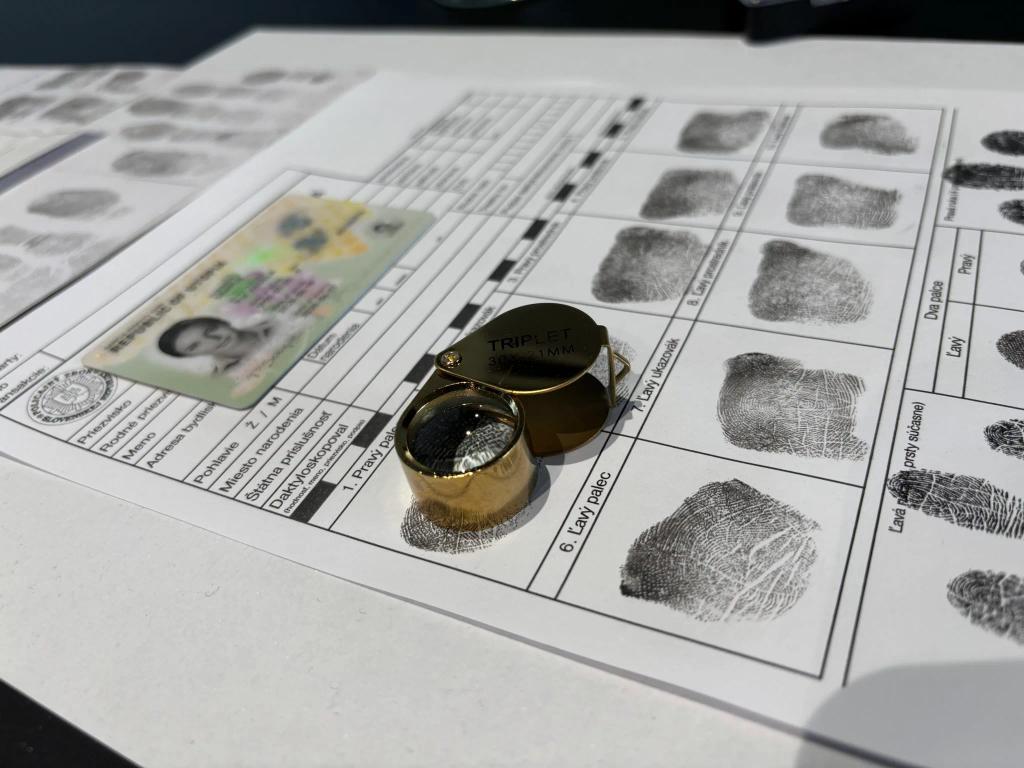
Latent fingerprints are mostly invisible impressions left on surfaces due to natural skin oils and sweat. They require specialized forensic fingerprint analysis techniques for detection and examination. By matching latent fingerprints to known fingerprints in a database, investigators can identify individuals involved in a crime based on their unique fingerprint patterns.

Latent Fingerprints & ABIS: Solving Crimes with Biometrics
Latent fingerprints can identify individuals involved in a crime

Challenges in Detecting and Analyzing Latent Fingerprints

Forensic teams face multiple challenges when handling latent fingerprints. Factors such as surface material, environmental conditions, and print clarity impact detection accuracy. Smudged or partial prints add complexity, making manual analysis time-consuming and less reliable.

Advanced fingerprint recognition technology and digital enhancement tools have significantly improved latent fingerprint analysis.

Why Latent Fingerprint Matching Is Critical in Criminal Investigations

Forensic teams collect latent fingerprints using techniques such as powder dusting, cyanoacrylate fuming, and multispectral imaging systems. Once developed, prints are photographed and digitized for forensic fingerprint analysis.

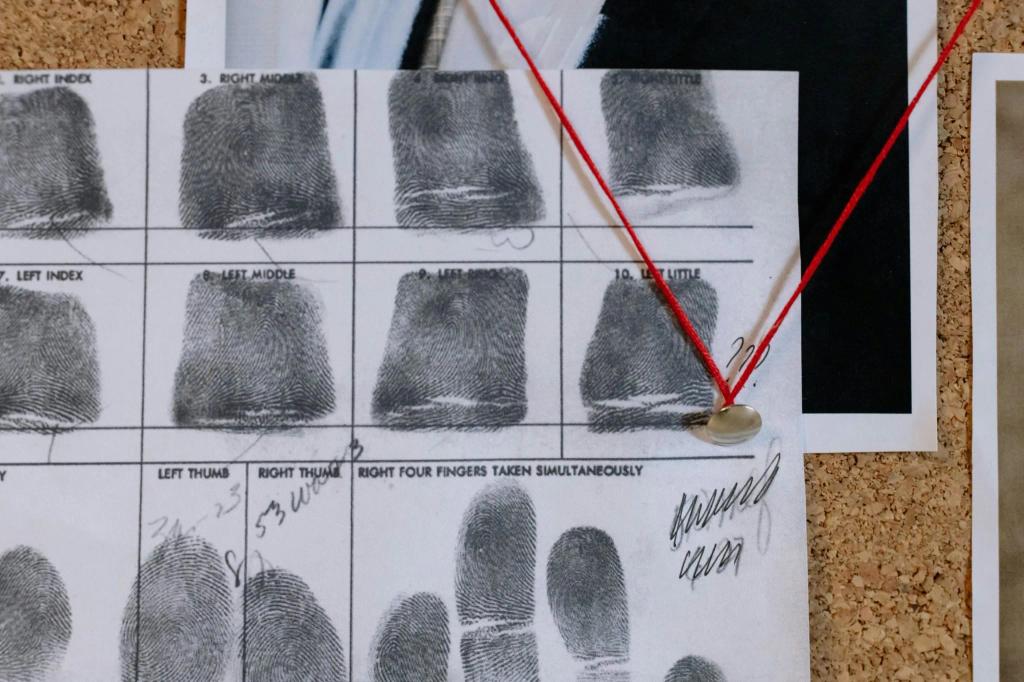
Fingerprint matching plays a major role in solving crimes, as fingerprints are unique and essentially remain unchanged even as people age. Even a partial latent print can help establish connections between a suspect and a crime scene. The high volume of fingerprint evidence collected in criminal cases necessitates automation.

Law enforcement agencies increasingly rely on Automated Biometric Identification Systems (ABIS) to process and match latent fingerprints against national and international criminal databases.

The Importance of ForenScope Latent Detection Device

ForenScope, a cutting-edge device utilized by law enforcement, offers a quick and efficient way to unveil latent fingerprints across expansive surfaces. By aiming the compact device at a potentially fingerprint-laden area and utilizing various light filters, investigators can expose all concealed fingerprints. The device then digitally captures these fingerprints, enabling seamless transfer for detailed analysis.

One remarkable benefit of ForenScope technology is its ability to capture fingerprints without the need for traditional powder and tape lifting methods. This non-intrusive approach preserves vital DNA evidence undisturbed. Additionally, law enforcement professionals can swab the surface to gather any supplementary DNA evidence while securely storing the digital fingerprints obtained through ForenScope for further investigative procedures.

What Is ABIS and How Does It Improve Fingerprint Identification?

An Automated Biometric Identification System (ABIS) is a technology-driven platform that automates fingerprint recognition technology, allowing for faster and more reliable biometric identification. ABIS integrates multiple biometric modalities, including fingerprints, palm prints, face, DNA, and iris recognition, to enhance forensic investigations.

This system is widely used by law enforcement agencies to manage criminal databases, improve fingerprint identification, and accelerate forensic fingerprint analysis. By leveraging ABIS, authorities can match latent fingerprints against vast databases of records within seconds, significantly improving investigative efficiency.

How ABIS Works for Latent Fingerprint Matching

  • Digitization: Crime scene fingerprints are scanned and their identification is enhanced using AI-powered software.
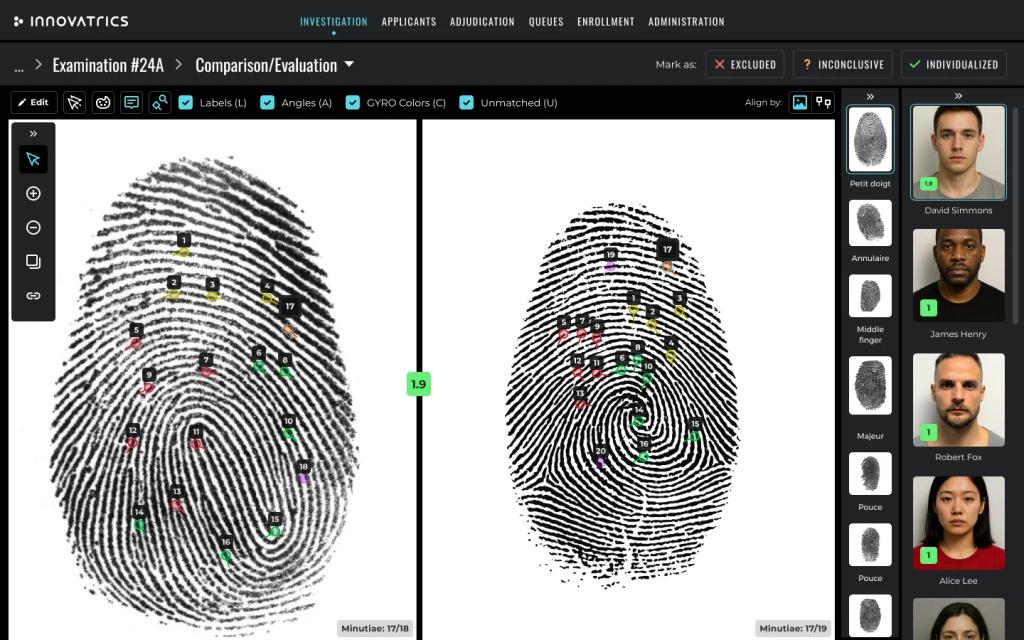
  • Feature Extraction: The system identifies unique fingerprint ridges, minutiae points, and patterns.
  • Database Identification: Latent fingerprints are matched against millions of records in criminal databases.
  • Candidate Ranking: ABIS generates a list of potential matches ranked by accuracy.
  • Verification: Forensic experts validate high-probability matches to confirm identities.
Latent Fingerprints & ABIS: Solving Crimes with Biometrics

How Criminal ABIS Strengthens Latent Fingerprint Analysis

ABIS enhances latent fingerprint examination by digitizing and automating key forensic processes. The system uses high-resolution scanners to collect fingerprint patterns from a person of interest and sophisticated algorithms to analyze ridges and minutiae points.

Innovatrics, a global leader in biometric identification, has developed a high-performance ABIS tailored for law enforcement. Their system integrates top-tier fingerprint recognition technology, enabling precise and rapid latent fingerprint identification.

Innovatrics’ latent fingerprint matching algorithm is ranked first in the NIST ELFT benchmark, confirming its latent fingerprint identification algorithm is the world’s most accurate.

Enhancing Fingerprint Examination with AI and Machine Learning

AI and machine learning have transformed forensic fingerprint analysis by improving accuracy, speed, and reliability. Traditional fingerprint-matching methods often struggle with partial, smudged, or low-quality latent prints. AI-driven systems address these challenges by learning from vast datasets and refining their recognition capabilities over time. Machine learning models can match latent fingerprints more effectively, even when human experts encounter difficulties by analyzing patterns and minutiae points with greater precision.

One of the key advantages of AI in fingerprint identification is its ability to adapt and improve with continuous exposure to new data. Unlike static algorithms, machine learning models evolve based on real-world inputs, increasing their effectiveness in identifying difficult or degraded prints. This adaptability is crucial for law enforcement agencies dealing with dynamic crime scenes where fingerprint quality varies significantly.

Reducing False Positives and Improving Database Matching

One of the biggest challenges in fingerprint recognition is minimizing false positives—incorrect matches that can mislead investigations. AI-powered ABIS reduces this risk by cross-referencing multiple fingerprint characteristics rather than relying on single-point comparisons. By analyzing ridge structures, pore distributions, and other micro-details, the system enhances the accuracy of fingerprint verification, lowering the likelihood of errors.

Additionally, AI enables more efficient searches across vast criminal databases. Law enforcement agencies often work with millions of fingerprint records, making manual or outdated matching techniques impractical. AI-driven systems can rapidly scan and compare latent fingerprints against large datasets, ranking potential matches based on probability scores. This prioritization allows forensic experts to focus on the most likely candidates, accelerating investigations while maintaining high accuracy.

Automating Latent Fingerprint Enhancement for Higher Accuracy

Poor-quality latent fingerprints are a major obstacle in forensic investigations. AI-based image enhancement techniques improve the clarity of fingerprint impressions by reconstructing missing ridge details, filtering out background noise, and optimizing contrast. These automated enhancements make previously unusable prints viable for forensic fingerprint analysis, increasing the chances of positive identification.

Moreover, AI-based ABIS systems leverage deep learning to recognize unique fingerprint characteristics even in complex conditions. Whether a print is distorted due to pressure variation or partially overlaid on another surface, AI algorithms can extract critical details for comparison. This capability significantly expands the usability of latent fingerprints, allowing law enforcement agencies to extract valuable evidence that would otherwise be overlooked.

Key Benefits of Using ABIS for Latent Fingerprint Examination

Automated Biometric Identification Systems (ABIS) offer a range of key benefits for latent fingerprint examination in forensic investigations. By streamlining the identification process and providing quick and accurate matching capabilities, ABIS enhances efficiency and accuracy in matching latent fingerprints to known prints.

Faster and More Accurate Fingerprint Matching

ABIS processes fingerprint data at a high speed, reducing the time required for latent fingerprint identification. By automating forensic fingerprint analysis, the system streamlines investigations, enabling law enforcement to act quickly on leads.

Improved Integration with Criminal Databases

One of ABIS‘s strengths is its ability to connect with national and international criminal databases. This integration allows law enforcement agencies to cross-reference latent fingerprints with existing records, increasing the likelihood of positive identifications.

Enhanced Scalability for Law Enforcement Agencies

ABIS is designed to support large-scale investigations. With the ability to store and process millions of fingerprint records, the system is highly scalable, making it a valuable tool for national security agencies and law enforcement departments handling high case volumes.

Real-World Applications of ABIS in Crime Solving

The deployment of ABIS has led to breakthroughs in crime investigations. Law enforcement agencies have successfully solved cold cases by matching latent fingerprints collected years ago with newly available database records.

For instance, ABIS has helped identify repeat offenders by linking multiple crime scenes through fingerprint identification. Criminal networks and organized crime groups have been dismantled through cross-border fingerprint recognition technology, proving ABIS’s effectiveness in global law enforcement.

The Indonesian National Police, managing a database of around 200 million records, required an efficient system for state-of-the-art fingerprint identification. Innovatrics deployed its ABIS solution, reducing identification times to seconds and significantly enhancing field operations. This real-world implementation demonstrates the impact of ABIS in accelerating criminal investigations.

fingerprint identification
Example of real-world fingerprints identification

Challenges in Latent Fingerprint Analysis and ABIS Deployment

While ABIS offers significant advantages, it also presents certain challenges. The quality of latent fingerprints can affect the accuracy of results. Smudged or incomplete prints may still require manual verification. Additionally, maintaining and updating criminal databases is essential for optimal system performance.
There are also considerations related to data security and privacy. As fingerprint recognition technology becomes more widespread, ensuring compliance with legal and ethical standards is crucial.

Privacy and Data Security Considerations

The increasing use of biometric identification raises concerns about privacy and security. Law enforcement agencies must:

  • Ensure compliance with international data protection regulations.
  • Implement robust cybersecurity measures to prevent unauthorized access.
  • Encrypt biometric records to safeguard sensitive information.

The Future of ABIS in Forensic Fingerprint Analysis

ABIS continues to evolve with advancements in AI, cloud computing, and deep learning. The next generation of fingerprint recognition technology will:

  • Improve matching accuracy through enhanced machine learning algorithms
  • Enable mobile forensic applications for field investigations
  • Strengthen global cooperation by integrating with international law enforcement databases

Why Law Enforcement Agencies Should Invest in Criminal ABIS Now

ABIS is no longer an optional tool—it is a necessity for modern criminal investigations. Agencies deploying ABIS benefit from:

  • Faster suspect identification and crime resolution
  • Higher accuracy with AI-powered fingerprint recognition
  • Stronger case outcomes with data-driven forensic fingerprint analysis

For law enforcement agencies looking to enhance forensic capabilities, Innovatrics ABIS offers a proven, high-performance solution. Its ability to process latent fingerprints with unmatched speed and accuracy makes it an essential tool in the fight against crime.

Send Us a Message

Share article:
  • Facebook
  • LinkedIn
  • X
  • Email
SOLUTIONS
  • Government ID & Phygital Identity
    • Biometric Platform for ID Issuance
    • Voter Management Platform
  • Criminal Justice & Law Enforcement
    • ABIS for Criminal Investigation
  • Border Control & Passenger Facilitation
    • Border Control Platform
    • Smart Corridors & eGates
  • Enterprise Identity Verification
    • Identity Verification Toolkit for Platforms
    • Enterprise Identity Verification Platform
    • Identity Verification Service
    • Identity Verification for System Integrators
  • Embedded Biometrics
  • Fingera - Time & Attendance Solution
  • Custom Projects
TECHNOLOGY
  • Core Biometric Tech
    • Fingerprint Recognition
    • Facial Recognition
    • Iris Recognition
    • Palm Recognition
  • Biometric Identity Verification
    • Face Verification
    • Age Estimation
    • Liveness Detection
    • Deepfake Detection
    • NFC Verification
    • Identity Document Verification
  • Insights Into the Technology of Trust
    • Building with Trust
    • Sharing Trust
    • Investigation with Trust
    • Trust the Vote
    • The Cost of Unfair AI
OTHERS
  • Resources
    • Case Studies
    • Downloads & Webinars
    • Events
    • Biometric Conference Series
    • Glossary
  • Company
    • About Us
    • News
    • Benchmarks & Certificates
    • Careers
    • Biometric Ventures
    • Our partners
  • EU Project
  • Contact Us
Innovatrics logo

Our passion for technology brings biometric benefits to millions of people.

    • Privacy Policy
    • Cookie Policy
    • Terms of Use

© 2026 Innovatrics. All rights reserved.